


How Do Nonprofits Make Money? FAQ Guide to Nonprofit Revenue
If you're considering starting a nonprofit, working with one, or even donating to one, it's important to understand what exactly these organizations are and how they manage their finances. There has been a lot of guidance from leaders in and out of the sector urging nonprofits to "operate like businesses." But if the purpose of a business is to make a profit, and nonprofits definitionally can't turn a profit, what does this recommendation actually mean? Moreover, how do nonprofits fund their work if they operate without profit?
These questions and many others are valid, especially if you're new to the nonprofit world. In this guide, we'll attempt to answer a few of them, particularly the ever-present question of how nonprofits make money. We'll cover the following:
- What is a nonprofit?
- How do nonprofit and for-profit organizations differ?
- How do nonprofits make money?
- What are the requirements for nonprofits to maintain 501(c)(3) status?
- How are nonprofit staff members paid?
Let's begin by considering what the term "nonprofit" actually means.

Level up your nonprofit's financial management by partnering with the experts at Jitasa.
Request a QuoteWhat is a nonprofit?
In non-financial terms, a nonprofit is a group of people joining together under a common cause and shared point of view to serve their community. In economic terms, it's an organization that reinvests all of its funding into its own projects and operations, and in return receives tax-exempt status.
In a for-profit business, the primary goal is to earn a profit that is distributed to the company's owners and shareholders. However, when an organization registers to be a federally recognized nonprofit with official 501(C)(3) status, it makes a promise not to distribute any money that is left over after expenses are paid. Instead, it uses all of its funding to further its efforts to positively impact its community.
How do nonprofit and for-profit organizations differ?
The greatest difference between nonprofit and for-profit organizations is the drive to make a profit. While it's the primary focus for businesses, it's not the driving factor for nonprofits. There are other differences in how these two types of organizations operate, however, that are important to take into account.
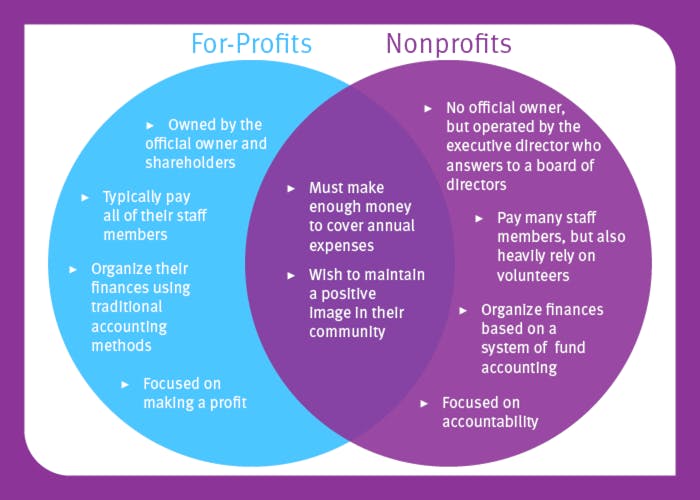
For-profit organizations:
- Are owned by the official owner as well as shareholders who share the profit of the company
- Typically pay all of their staff members, except occasionally those hired for an internship
- Organize their finances using traditional accounting methods to cover all expenses while still providing a profit for owners and shareholders
Nonprofit organizations:
- Have no official owner, but are operated by the executive director who answers to a volunteer board of directors
- Typically pay many staff members, but also rely heavily on a network of volunteers who help keep the organization running smoothly while sticking to a tight budget
- Organize finances based on a system of fund accounting to ensure all expenses are covered and any restrictions on income are accounted for
Both nonprofit and for-profit organizations must make enough money to cover their expenses and stay afloat. They also both wish to maintain a positive image in the eyes of the public to continue earning money and growing their organizations.
How do nonprofits make money?
There are restrictions on the ways nonprofits can generate revenue under their tax-exempt status, particularly regarding unrelated business income (UBI). However, nonprofits can generate revenue from a variety of sources—in fact, they should incorporate multiple revenue streams into their funding model, since diversification is essential for financial sustainability.
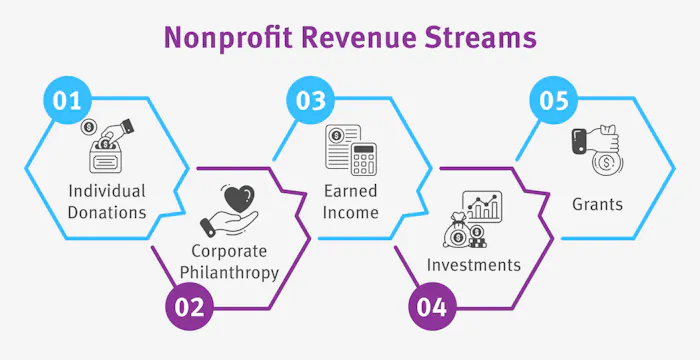
To help your nonprofit avoid putting all of its revenue generation eggs into one basket, let's walk through the five major categories of nonprofit revenue in detail.
Individual Donations
If you've ever personally donated to a nonprofit, the organization reported your gifts as individual contributions. Individual donations are contributions to nonprofits from general supporters, mid-tier donors, and major givers.
In addition to the range in donation sizes, individual donations may also look different based on what is contributed, how it's donated, and what the gift even is. For instance, consider the following types of individual donations:
- Event contributions. Donations made as a part of event registration or donated at your organization's fundraising events are given by individual donors and are therefore counted in this category.
- Online donations. While it's easy to think of individual donations as those you solicit via mail or in-person discussions from major donors, the gifts you receive via your online donation page will add up to a significant portion of your individual donations.
- Stock donations. Sometimes, supporters will contribute stock holdings to your nonprofit rather than direct funds. These donations are sometimes made through donor-advised funds and often allow the donor to give more compared to if they sold the stock first.
- Planned gifts. Planned gifts are those promised to nonprofits but paid out at a later date, often in the form of a will or a trust. These gifts are often large and paid out after a donor passes away.
- In-kind contributions. In-kind donations are gifts of items rather than money, but their value must be recorded in your accounting system as donations. They can come either from individual donors or from other organizations.
Nonprofits typically spend a lot of time working to acquire individual donors. They don't want them to be tempted to take their generosity elsewhere! That's why nonprofits focus a lot of their efforts on the retention of individual supporters, ensuring they become more and more invested in the cause. Retaining important supporters does wonders to ensure sustainable funds for the future.
Corporate Philanthropy
In addition to individuals, for-profit organizations often give back to nonprofits that align with their values and serve the community they also rely on to thrive. Some popular corporate philanthropy programs include:
- Employer matching gifts, in which businesses match their employees' financial contributions to eligible nonprofits.
- Volunteer grants, in which companies donate money to nonprofits that their staff members volunteer with regularly.
- Payroll donations, in which employers give their employees the option to have a portion of each paycheck automatically contributed to a nonprofit of their choice.
- Internal employee fundraising campaigns, in which staff members make financial or in-kind donations to a nonprofit chosen by their employer during a specific period of time.
- Corporate sponsorships, in which a company provides monetary or in-kind support for a designated initiative, such as a fundraising event or building project, in exchange for business publicity.
Corporate philanthropy is a win-win for your nonprofit and the businesses you partner with. Your organization receives additional funding and forms connections within its community, while businesses increase employee engagement and boost their reputations as socially responsible companies.
Earned Income
While many nonprofits put a great deal of emphasis on donations and fundraising initiatives, these organizations often also make money through earned income. They self-generate funds to contribute to their budget and help the organization stay afloat.
To maintain a 501(C)(3) status, this revenue needs to be directly related to the organization's mission in order to remain tax-exempt. Earned income can come in many forms, including:
- Sales of merchandise
- Fees charged for services
- Membership fees
- Renting out physical space
Earned revenue streams must be reported differently if they don't share a direct link with the nonprofit's mission. Therefore, if you work with an organization that relies on earned income and are unsure of its relevance to your cause, always discuss these avenues with an accountant. They'll help you determine if it falls within the mission and how to report it properly come tax season.
Investments
One way for nonprofits to make money that is not widely used among organizations is investing. A nonprofit can open a brokerage account just like an individual investor can. Even better, their tax-exempt status means that nonprofits may not even have to pay the income tax on portfolio dividends and gains.
When nonprofits invest their money, they're usually not doing so as a main source of income. However, it can help organizations build assets. The other reason they may invest is to grow long-term savings and bolster their reserve funds.
The most common form of investment for nonprofits is an endowment. This is a specific type of investment, often restricted by a major donor. They generally require the initial donation be invested, but the nonprofit receives the dividends of that account as regular contributions to the organization. This income may or may not be restricted by the donor, but the dividends provide a sustainable source of income for the nonprofit.
Grants
Applying for grants is another important way in which nonprofits make money. Grants are often provided by other organizations to help nonprofits accomplish very specific goals. The grantor needs to make sure that their funding is going to a good cause, that the goal is achievable, and that the interests of the nonprofit align with the mission of the grantmaker. Therefore, your nonprofit needs to consider all of these factors when writing grant proposals.
Some of the organizations that offer grants for nonprofits include:
- Government entities
- Public charities
- Community foundations
- Family foundations
- Private foundations
One of the most important things nonprofits need to consider when applying for grants is the instructions for the application process. Grantors typically require specific guidelines to be met in the proposals submitted by nonprofits, so they need to carefully ensure they've met those guidelines and presented a compelling argument for why they deserve the funds.
Grants can present a challenge as nonprofits are managing their finances. Grant funding is often restricted to the project for which the nonprofit has requested the funds. Therefore, they need a method for tracking the funding they use and ensuring that grant funding is only used for the project at hand.
On top of that, nonprofits need to have an effective management system in place to make sure they can report how funding was spent back to the grantor on the right timeline. This means having a detailed calendar to track deadlines for different grants and effective reporting processes to provide necessary information back to the grantmaking organization.
What are the requirements for nonprofits to maintain 501(c)(3) status?
When nonprofits register to become 501(C)(3) organizations, they agree to take certain steps to ensure their compliance with federal regulations in return for their tax-exempt status and nonprofit benefits. Essentially, they're agreeing to reinvest all of their funding back into the organization rather than taking that money straight to the bank for individual gain.
The federal government has requirements to ensure organizations are not abusing their tax-exempt status and are complying with this agreement. To maintain their tax-exempt status, nonprofits must take the following actions:
- Always filing their annual tax return with the IRS to report on their gross receipts and how they used their funding over the course of the year.
- Acknowledging all donor gifts over $250 by providing a written receipt.
- Maintaining a formal process for managing contractors and compensation agreements with outside and inside employees to ensure that it is in service of the public and not private interests.
- Familiarizing themselves with and adhering to potential restrictions on lobbying to avoid breaking rules or crossing lines.
- Avoiding engaging in political campaign activity that can be construed as favoritism, such as selling mailing lists, renting offices, or paying for political advertising.
- Paying taxes on unrelated business income.
- Asking the right questions when consulting with a lawyer or nonprofit accountant.
Nonprofits that lose their 501(C)(3) status would need to pay taxes on all of the contributions they receive, so it's an expensive mistake to make. Not only that, but they would also need to register to become an official 501(C)(3) organization again, which also requires the organization to pay a fee.
Learn financial basics in The Beginner's Guide to Nonprofit Accounting.
Download for FreeHow are nonprofit staff members paid?
We've reviewed a lot about how nonprofits make money as an entire organization, but what about the staff members and founders? At for-profit companies, the owners of the organization and the shareholders split the profit and take it home. But nonprofits work differently.
Remember that nonprofit organizations have founders--not owners. These founders cannot benefit from the net earnings of the organization, although they can collect a salary. Nonprofits can (and do) try to achieve positive revenue with enough leftovers to save for future operational experiences or emergencies. But the profit is never distributed to an individual or private interest.
Nonprofits also often put in place a compensation policy to help them determine how much top executives will be paid in salary and ensure that amount is in line with other similar organizations. This policy outlines the research process for determining salary thresholds.
Past the compensation policy, many nonprofits focus their efforts on offering a well-rounded compensation policy for their staff members. This means they want to offer additional benefits past the monthly paycheck. They also often offer incentives such as:
- Increased flexibility. Nonprofits are often more flexible about some day-to-day considerations, including work schedules or work-from-home opportunities.
- Better benefits. Nonprofit organizations offer normal benefits for full-time employees (like medical and dental insurance, life insurance, and retirement plans), but they often go above and beyond. Staff members may get opportunities for sabbaticals, tuition reimbursement, or additional vacation time.
- Purposeful work. For many people, the opportunity to do important work in service of others is the main driver for joining the staff of a nonprofit.
- Good community culture. People like working in environments where they feel respected, valued, and useful to their communities and their leadership. Nonprofits tend to develop a positive company culture that keeps people around.
While nonprofits don't take home profit in the same way a for-profit does, they still allocate some of their regular funding to take care of staff members. Offering a competitive salary along with the additional benefits of working in the nonprofit sector helps nonprofits keep staff members around longer. Retention is essential for nonprofit financial success as hiring to replace lost staff is so expensive.
Although nonprofits can't turn a profit by definition, managing revenue properly is still important to ensure your organization has enough money to continue providing services, save for a rainy day, and pay its employees a good wage. Diversifying your revenue model to include all of the different ways nonprofits make money—individual donations, corporate philanthropy, earned income, investments, and grants—is the first step in funding your mission for years to come.
For more information on nonprofit revenue generation, check out these resources:
- Restricted Funds: Everything Your Nonprofit Needs to Know. Discover what to do when donors or funders designate the revenue they give to your nonprofit for specific purposes.
- Nonprofit Revenue Recognition: What It Is & Why It Matters. Learn how and when to track the funding your organization brings in from various sources for compliance purposes.
- 12+ Top Nonprofit Accounting Firms & How to Choose One. Explore our picks for outsourced nonprofit accountants who can help your organization manage its revenue effectively.
Learn more about how nonprofits make and allocate money.
Talk to a Jitasa accountant