

What's the ROI of Outsourced Nonprofit Accounting Services?
Tuesday, November 3, 2026 by Jon Osterburg
If your nonprofit’s staff is feeling overwhelmed by the various financial management tasks that are necessary to keep your organization operating efficiently and furthering its mission, you may be considering outsourcing this function to an external accounting firm. However, one barrier that frequently prevents nonprofits like yours from leveraging outsourced accounting services is uncertainty about whether outsourcing is truly worth it.
The short answer to the “Is it worth it?” question is usually yes. But because every nonprofit is different, it helps to examine why outsourced accounting is worth the resources and effort you put into securing these services. In this guide, we’ll look more closely at the return on investment (ROI) of outsourced nonprofit accounting by answering the following questions:
- What are the different types of nonprofit accounting services?
- Should you outsource your nonprofit’s accounting?
- What are the benefits of outsourced nonprofit accounting?
- What considerations should you keep in mind when outsourcing your accounting needs?
- What ROI will your nonprofit see from outsourcing its accounting?
- What type of ROI do Jitasa clients see?
Before we dive into the unique value outsourcing can provide, let’s review how outsourcing compares with other nonprofit accounting service options.

Access affordable, scalable, expert nonprofit accounting services by partnering with Jitasa.
Request a QuoteWhat are the different types of nonprofit accounting services?
Generally speaking, there are three ways your nonprofit can partner with an accountant: hiring an accountant in-house, accepting an in-kind gift of service, and outsourcing. Here is a quick breakdown of the pros and cons of each method:
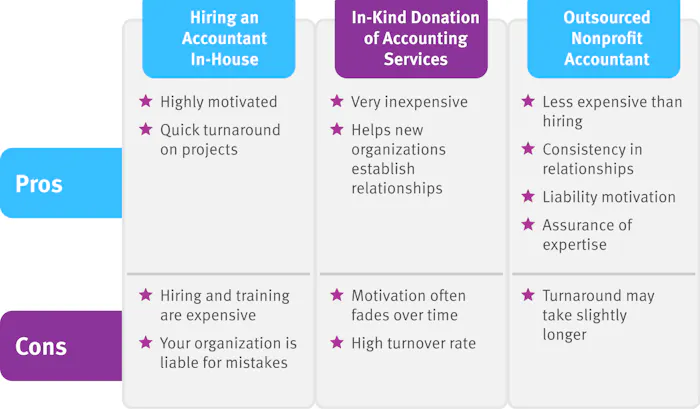
- Hiring an accountant in-house: Very large nonprofits with complex financial needs often benefit from hiring a full-time accountant who can dedicate all of their time to that organization. In-house accountants are usually very motivated and turn projects around quickly, but they’re expensive to hire, train, and compensate. Plus, your organization is liable for any mistakes they may make.
- Receiving an in-kind donation of accounting services: This is often an accessible way for very small or brand-new nonprofits to get started with accounting because it’s free. It also helps new organizations establish professional connections, which helps build their reputations. However, this method has a high turnover rate due to unpaid accountants’ motivation fading over time or their allowing paid projects to take precedence over pro bono work.
- Outsourcing to an accounting firm: Most nonprofits that fall in between the largest and smallest organizations find outsourced accounting to be the best option for them. Outsourcing provides access to proven financial expertise at a fraction of the cost of hiring, as well as consistent relationships with an accounting team that has its own liability insurance. Turnaround times can be longer depending on the outsourcing firm you work with, but effective communication will help you overcome this hurdle.
Whichever method you choose, your accountant will likely complete a variety of tasks related to financial data analysis and reporting, from organizing records and reconciling bank statements to compiling financial statements and filing tax forms.
Should you outsource your nonprofit’s accounting?
The answer to this question is almost always yes, unless:
- Your nonprofit is so large and complex that you have enough accounting work for someone to spend at least 40 hours per week dedicated to it.
- Your organization is so small or new that you have no budget for accounting services, and a skilled volunteer completing a few tasks here and there would be sufficient.
- You currently have an accountant on staff who is managing your finances well, and you can afford to compensate them fairly—no need to change what’s already working!
In these situations, you may still keep outsourcing in mind as an option so that if changes occur (e.g., if your new nonprofit outgrows its donated services or your internal accountant leaves), you can investigate this option early and keep your finances on track. If you aren’t sure whether these cases apply to your nonprofit, take the quick quiz below to find out!
QUIZ: Should You Outsource Your Nonprofit’s Accounting?
Answer Yes or No to each question below to see if outsourced accounting is the right move for your organization.
Your Result
Learn more about Jitasa’s outsourced financial services for nonprofits.
View ServicesWhat are the benefits of outsourced nonprofit accounting?
Outsourcing your nonprofit’s accounting can provide a variety of advantages, including:
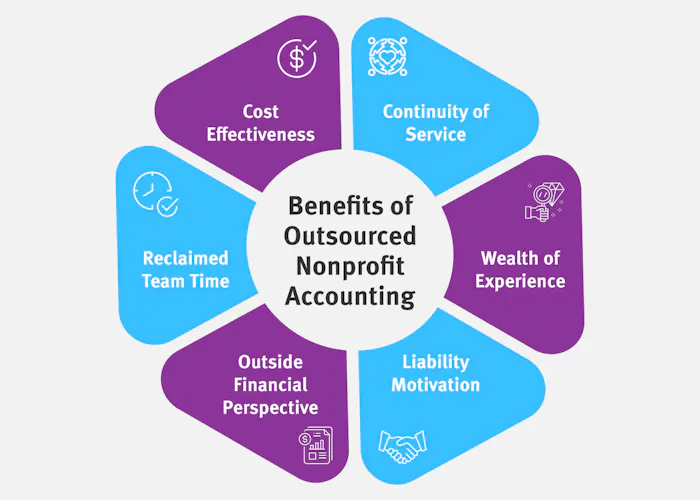
- Cost effectiveness, especially as compared to hiring (firms’ monthly rates are typically much less than a complete employee compensation package would cost, plus there are no recruitment or training costs).
- Continuity of service thanks to a team-based model that ensures you'll always be able to communicate with someone familiar with your organization’s situation, regardless of time off or employee turnover at your partner firm.
- A wealth of experience managing other nonprofits’ finances, so if you find yourself in a complicated accounting situation, your partner has probably seen something similar before and can use their prior knowledge to solve your problem.
- Liability motivation—external accounting firms (not their clients) are liable for their employees’ mistakes, giving them an additional incentive to complete all work for your nonprofit thoroughly and accurately.
- An outside perspective on your nonprofit’s finances, which provides a more objective view of your situation than your internal team could see on your own, as well as help with capitalizing on your strengths and improving on weaknesses.
- Reclaimed team time to focus on fundraising and service delivery rather than crunching numbers and filling out paperwork.
Depending on the firm you partner with, you may also be able to access other financial services under the same roof. For example, Jitasa offers outsourced controller services, fractional CFO assistance, and bookkeeping support, in addition to accounting.
What considerations should you keep in mind when outsourcing your accounting needs?
To maximize the benefits of outsourced accounting, your nonprofit needs to find the right fit by asking the right questions of potential partners. Some key areas to consider include:
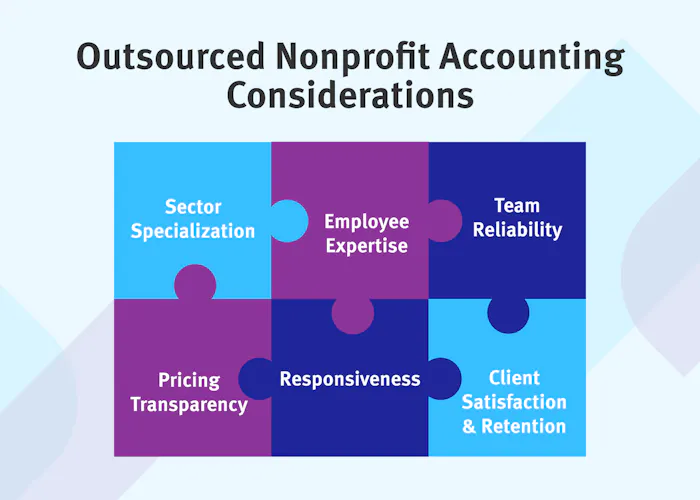
- Sector specialization: Remember that previous nonprofit experience is essential for your accounting partner to fully understand your financial situation, and firms that exclusively serve nonprofits are even better since they’ll be set up and priced specifically for your organization’s needs.
- Employee expertise: Investigate the general credentials and professional backgrounds of a firm’s staff members to make sure you’ll get a well-qualified team.
- Team reliability: Confirm that the firms you consider run on the aforementioned team-based model, and that they have high employee retention rates and strong controls and insurance.
- Client satisfaction and retention: Research third-party ratings and data, and read testimonials from past and current clients to get additional insight into how each firm operates.
- Responsiveness: Ask potential partners about their typical turnaround times, contact preferences, and expectations of you as a client to keep communication lines open and get projects done efficiently.
- Pricing transparency: Review firms’ pricing structures to see whether they offer fixed monthly rates with no hidden costs that are clearly spelled out in client contracts, along with other stipulations and security measures.
Start your search for an outsourced accounting firm by casting a wide net. Then, narrow down your options through online research and recommendations, and schedule meetings with your top two or three potential partners before making your final decision.
Learn more about choosing the right nonprofit accounting partner in our complete buyer’s guide.
Download for FreeWhat ROI will your nonprofit see from outsourcing its accounting?
There is no single answer to the question of outsourced accounting ROI, as this calculation depends on many factors surrounding your nonprofit and your partner firm. However, you can get an idea of what your organization might gain by determining:
- The difference in cost between outsourcing and hiring
- The value of the additional time your team will gain to focus on other mission-critical tasks
- The non-compliance penalties and other financial risks that your outsourcing partner will help you avoid
- The additional contributions you’ll receive (and therefore, the impact you’ll be able to make) by being more financially transparent
If you translate these values into numbers, you can figure out your approximate outsourced accounting ROI. Remember that this calculation is only an estimate, and your organization’s returns can vary from year to year.
What type of ROI do Jitasa clients see?
Jitasa is the largest national provider of nonprofit-specific accounting and financial services. We’ve served more than 2,000 clients of various sizes and missions since our founding in 2008, and 92% of our clients return year after year because they see results that make their investment in our services worthwhile. Here are just a few examples of client success stories we’ve been honored to be part of:
- The Farmers Land Trust more than doubled its revenue each year during its first three years operating independently, thanks to the strong financial foundation the Jitasa team laid as it transitioned from a fiscal sponsorship model to a 501(c)(3) structure.
- The YWCA of the Harbor Area leveraged the time it reclaimed and the financial insights it gained by working with Jitasa to launch a brand-new food distribution program that now provides fresh food to more than 1,000 families each month.
- Family Promise of Forsyth County gained the confidence to apply for additional grant funding and launch a capital campaign to build a new office and day center, knowing they had Jitasa on their side to help them understand and track their finances.
While these success stories represent some of the higher-level achievements we’ve seen, nearly every Jitasa client has experienced a positive ROI from their accounting services in the form of more efficient resource allocation, greater financial stability and transparency, and additional time to dedicate to their missions.
As long as your nonprofit chooses the right outsourced accounting partner, you should see positive results from your investment in these services. Remember that your exact ROI will vary depending on your organization’s unique situation, but most experienced accounting professionals—like the team at Jitasa—are dedicated to providing the greatest possible value to each individual client, regardless of their needs.
For more information on outsourced nonprofit financial services, check out these resources:
- 12+ Top Nonprofit Accounting Firms & How to Choose One. Explore our full list of the best outsourced nonprofit accountants so you can assess all of your options.
- What Is a Fractional CFO for Nonprofits? The Ultimate Guide. Dive deeper into another type of outsourced financial service—fractional CFO support—to see if it’s right for your nonprofit.
- Nonprofit Bookkeeping & Accounting Services | Jitasa Group. Learn more about Jitasa’s outsourced accounting and bookkeeping services designed exclusively for nonprofits.
See how Jitasa's affordable, tailored bookkeeping and accounting services can work for your nonprofit.
Request a Quote