


Nonprofit Compensation Policy: What You Need to Know
Friday, February 13, 2026 by Jon Osterburg
Nonprofits have a reputation for paying their employees less than for-profit organizations. However, even if your organization has limited resources, you can still provide fair and competitive nonprofit compensation. Doing so enables you to better retain employees, which saves money in the long run by decreasing recruitment and onboarding costs.
To offer fair compensation practices, you’ll need to implement a nonprofit compensation policy. In this article, we’ll dive into what this policy is and why it’s essential for your nonprofit to have one. Here are the general topics we’ll cover:
- Nonprofit compensation policy FAQ
- Requirements Regarding Compensation for Nonprofit Employees
- Elements of a Nonprofit Compensation Policy
- Sample nonprofit compensation policy
- Setting strategic compensation plans for nonprofits
Before we dive into creating your organization’s policy, let’s make sure we’re all on the same page by answering a few commonly asked questions about nonprofits and compensation.

Get the financial advice you need to master your compensation strategy.
Work With JitasaNonprofit Compensation Policy FAQ
Do nonprofit organizations have paid employees?
Yes! Any organization, including nonprofits, that formally employs individuals pays their employees.
When it comes to nonprofit compensation standards, there can be confusion over the difference between salaried employees and unpaid volunteers. While volunteers often perform many tasks that employees would, and some nonprofits are even entirely volunteer-run, these supporters aren’t formally employed. As such, they don’t receive compensation, but formal staff members do.
What is a nonprofit compensation policy?
Nonprofit compensation policies outline the process of how the organization determines staff salaries and other compensation benefits. Specifically, this policy outlines the procedure to decide executive members’ salaries.
At a for-profit business, sole proprietors are generally paid through draws on the company's income. The income generated through a business is considered to be an extension of the business owner, and salaries paid to employees are considered an expense.
However, nonprofits operate a bit differently. According to nonprofit accounting guidelines, as a registered 501(C)(3), nonprofits must reinvest the funds they earn back into the organization. That means the funds belong to the organization rather than to the executive. Therefore, the leaders and other staff members must take a salary that is agreed upon as part of the organization’s overhead expenses.
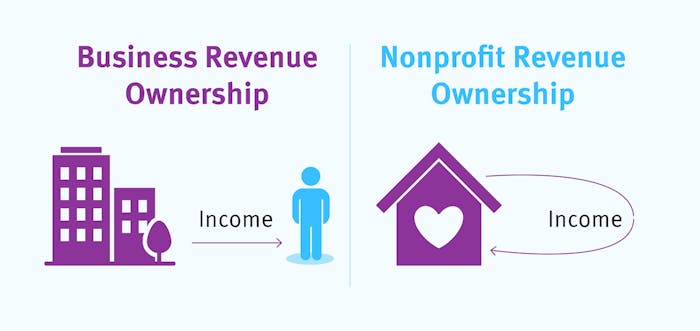
Asking the executive director to choose their own salary is obviously a conflict of interest, so a nonprofit compensation policy outlines a clear process for doing so fairly.
What is considered reasonable compensation for nonprofit staff?
Every nonprofit is different, and various organizations employ different workers with unique experience and skill levels. This means there is no standardized compensation policy across the nonprofit sector.
That being said, nonprofits looking to offer reasonable compensation can do so by working with an HR consultant to perform a compensation survey. Compensation surveys help all types of organizations offer competitive compensation by analyzing wage data related to their open positions.
These surveys primarily take the following factors into account:
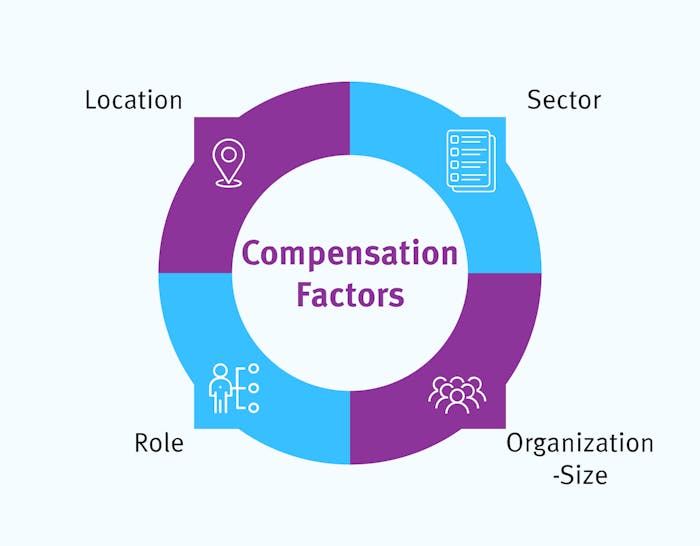
- Location. Different areas have different costs of living, and organizations operating in those areas are expected to offer accommodating salaries. For example, a small rural town in upstate New York likely has a significantly lower cost of living—and subsequently lower average compensation rates—than New York City.
- Sector. When completing a compensation survey, ensure you’re looking at data specific to nonprofits. If possible, consider not just nonprofits in general, but also your individual vertical. For example, a nonprofit healthcare organization would likely consider other nearby healthcare facilities, while a university would look to other higher education institutions.
- Organization size. A small business’s top executive likely has a lower salary than the CEO at a Fortune 500 company. This same principle applies to nonprofits, so ensure you assess organizations with similar resources to yours.
- Role. In general, the more experience and expertise a role at your nonprofit requires, the higher the compensation will be. This is especially true for leadership roles—such as executives—where you may be competing with other organizations to attract a handful of qualified candidates’ attention.
Additionally, what is considered “reasonable” compensation today might be unreasonable in a few years due to inflation, changes in the job market, and other external factors. Perform compensation surveys whenever you plan to conduct a new round of hiring or at least every two to three years to ensure your nonprofit continues to offer competitive compensation.
Get your finances in order with The Beginner’s Guide to Nonprofit Accounting.
Download for FreeRequirements Regarding Compensation for Nonprofit Employees
501(C)(3) requirements mean that all of the organization’s funds need to be reinvested back into itself. The IRS has set specific requirements for nonprofit compensation policies to help determine salaries. It requires that salaries:
- Are considered reasonable, but not excessive. Generally, this is the greatest concern for the executive director’s salary. Unfortunately, there are people who will try to take advantage of a nonprofit’s tax-exempt status and set up false organizations or manipulate the systems to earn additional money. This requirement prevents fraudulent behavior and preserves the integrity of nonprofits like yours.
- Include benefits and bonuses as a part of overall compensation. When recording and reporting compensation, you need to do so in its entirety, including bonuses and benefits you provide for staff members. This holistic approach considers all organizational expenses relevant to compensation—such as insurance coverage and tangible gifts—to ensure everything is properly accounted for.
- Are reported transparently on an annual basis. On your nonprofit’s Form 990, you must disclose the salaries of the five highest-paid employees to the IRS. Keep in mind that Form 990s are public documents, so the highest-paid employees’ salaries will be publicly visible for at least three years after you file your return.
It’s highly recommended that your nonprofit’s board of directors play a part in setting compensation for executives. Revisit this conversation on an annual basis to ensure continued governance. Then, the executive director can follow the guidelines in the compensation policy to set the salaries of other staff members.
Nonprofit executive compensation
Your nonprofit compensation policy should have provisions and processes outlined to ensure your executive director’s compensation is reasonable but not excessive.
The recommended process to determine the right compensation is to research other nonprofits’ executive compensation policies. Conduct a compensation survey specifically for an executive role, assessing executives who work with:
- Similar types of organizations
- Similar-sized organizations
- Organizations in the same general region
If you need additional assistance completing this survey, factoring in benefits alongside monetary compensation, or considering unique circumstances, consider working with a nonprofit HR specialist.
Penalties for excessive compensation
When we hear about nonprofits paying their executives a high amount of money, our minds often immediately jump to stories of corruption in the sector. This corruption is precisely what the IRS and state governments are trying to prevent by creating compensation stipulations.
Your nonprofit compensation policy should help your organization remain compliant with these regulations and avoid any assumptions of corruption.
If the IRS finds that an organization has issues with excessive compensation among the highest-paid employees, that nonprofit may face heavy penalties.
Specifically, if the IRS flags potential violations related to excessive compensation, the organization may be required to undergo:
- An official IRS inquiry or audit to further examine the situation
- Additional investigation at the state level
- Payment of heavy fines
To avoid these penalties, ensure the processes in your nonprofit compensation policy are clear, follow the rules, and leave a paper trail that you can use to back up your decisions to the IRS if necessary.
Penalties don’t only come from the IRS. If you overpay your staff members, you likely won’t have the funds to effectively run your nonprofit’s programming.
Calculating your nonprofit’s program efficiency ratio can help with this decision. Find your ratio with our calculator. If your ratio is below 75%, it’s a sign you might be paying your employees too much rather than allocating the necessary resources toward your mission and programs. Strike a balance between paying your employees what they deserve and ensuring you have the funds to continue pursuing your mission.
Elements of a Nonprofit Compensation Policy
Different organizations often have slightly different items in their compensation policies, but they generally observe a common outline. Most nonprofit compensation policies include the following information:
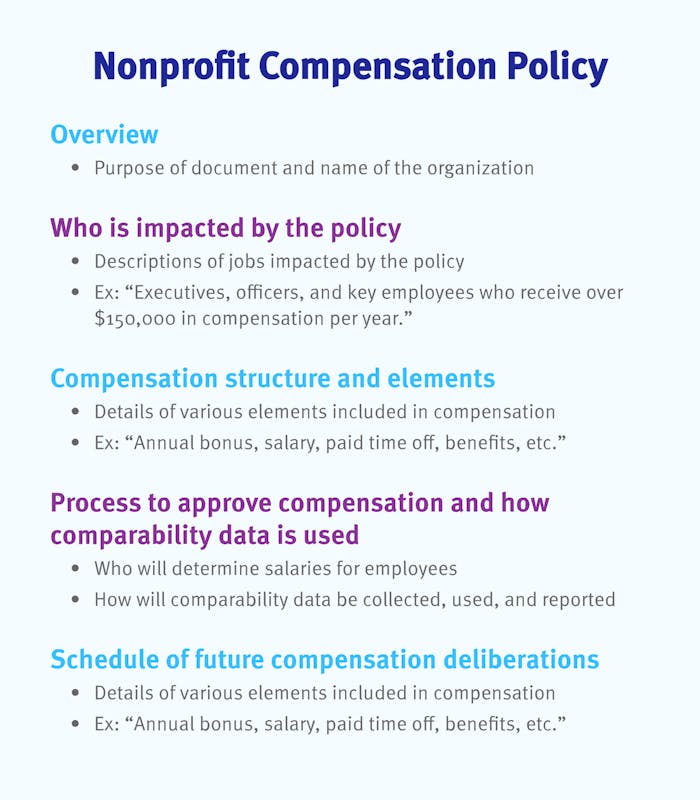
- Overview or philosophy: The first section of a nonprofit compensation policy commonly includes an overview discussing the purpose of the document, how to read it, and sometimes the values the organization holds regarding compensation.
- Information about who is affected by the policy: Some organizations’ compensation policies include information about compensation for all staff members, while others simply provide information about their executives. This section of your policy will explain which roles are covered by the policy process.
- Compensation structure and elements: Because your Form 990 requires you to report all aspects of your compensation policy, your organization should discuss the various elements of your compensation plan in this section of the policy, including any retirement funds, paid time off, bonuses, other benefits, and, of course, salaries.
- Procedure for approving compensation: Explain step-by-step how your organization determines compensation, including how board members are involved in setting executives’ salaries. For instance, if you take votes on final compensation decisions, you might require two-thirds of board members to agree or a simple majority.
- Comparability data information: Discuss how you’ll use the data that you collect from other organizations regarding their compensation information. Sometimes this section is lumped into the “procedure for approving compensation” section, but other times, it’s noted separately.
- Schedule of compensation deliberations: Create a general schedule for how often you’ll review compensation for relevant parties.
Generally, it’s best to contact a lawyer and a financial advisor to help you determine the best information to include in your compensation policy and to look over your policy after you’ve completed it.
Nonprofit compensation and conflict of interest policies
In addition to your organization’s nonprofit compensation policy, you should also make sure to have a conflict of interest policy. This policy has some overlap with your compensation policy, as both ensure your organization remains compliant and prevents fraud.
Conflict of interest policies establish rules to prevent leaders from gaining personal benefits from the organization’s public funds.
For example, an executive at your nonprofit might also work as a consultant for another company and sign the nonprofit up for services from that other company. If the executive gains financially from the agreement, it would likely be considered a conflict of interest.
If anything goes wrong or the IRS identifies a risk of overcompensation, the first thing they look for is any conflict of interest at a nonprofit. Having a clear policy for disclosing and managing conflicts of interest can reduce the risk of penalties in these situations.
Sample Nonprofit Compensation Policy
Now that you understand what is included in your nonprofit compensation policy, you might be asking, “But what does this document actually look like?”
Below is a template that shows the general outline of a nonprofit compensation policy. Keep in mind that this template shows your policy all on a single page, when they’re actually much longer in most cases. Don’t be surprised if you draw up a multi-page document for your compensation policy.
If you’d like to see other versions of nonprofit compensation policies, check out the following examples:
- The Fuller Center Manual Compensation Policy Template
- Sample Nonprofit Compensation Policy from National Council of Nonprofits
As you read through these samples and explore this template, keep in mind that all information in this article, images, and resources provided should not be considered legal advice or used as such. It’s always best to consult with a lawyer when compiling official policies and documentation for your nonprofit.
Setting strategic compensation plans for nonprofits
A 2023 study on the state of the nonprofit workforce found that salary competition is the greatest factor impacting retention and recruitment, with approximately 72% of nonprofits reporting struggles with this challenge.
As you’re considering your nonprofit compensation policy, don’t forget to consider your organization's overall staff retention strategy as well.
Remind staff members of your holistic approach to compensation, such as the benefits you offer, like paid time off and professional development, in addition to salaries. Make sure each element of your compensation packages is competitive with the other positions they may be considering.
In addition, when staff members do resign, conduct an exit interview so you can ask why they decided to leave. Include compensation questions in this interview so you can see where your organization’s approach falls in comparison to your competitors.
Effective compensation will factor into your employee retention rate and help save your organization money in the long run. However, it can be challenging to ensure you’re paying team members enough while preventing excessive compensation, especially when considering compensation for executives.
If you need help setting a compensation policy that is effective and compliant, consider discussing the matter with nonprofit finance professionals as well as a lawyer. The Jitasa team will be happy to help! We’ll help walk through what you need in your nonprofit compensation policy, as well as how to do the necessary research to determine the best holistic compensation plans for your employees.
To learn more about compensation and general nonprofit financial management, check out the following resources:
- Nonprofit Financial Management: Overview + Best Practices to Know. Managing your finances can seem challenging, but this guide will walk you through the best practices that all nonprofit teams need to know.
- How to Leverage Nonprofit Financial Ratios + Calculators. Financial ratios can help you assess your nonprofit’s spending, helping you set fair compensation. Leverage our calculators to determine your nonprofit’s ratios.
- How to Set up QuickBooks for Nonprofits: The Complete Guide. Accounting software is essential for making smart financial decisions. Learn how your nonprofit can get started with one of the most popular accounting platforms.