


Understanding Your Nonprofit NTEE Code: A Complete Guide
Tuesday, February 17, 2026 by Katie Simpson
Nonprofits exist to further a wide range of missions, from educational reforms to environmental preservation. However, the framework in which these organizations operate is critical to their success. A cornerstone of this framework is the effective and precise classification of an individual nonprofit's purpose and activities.
To help donors, nonprofit professionals, government entities, and other stakeholders categorize nonprofits, the IRS created National Taxonomy of Exempt Entities (NTEE) codes. Understanding and applying the correct NTEE code to your organization is crucial, as it influences funding opportunities, tax exemptions, and compliance with federal regulations.
In this guide, we’ll dive into the anatomy of an NTEE code, explaining its importance and how to apply it effectively. We’ll cover:
- NTEE Code FAQ
- The Importance of Accurate NTEE Classification
- How to Determine Your Nonprofit’s NTEE Code
- NTEE Codes & Nonprofit Financial Management

Set your nonprofit up for financial success by working with the experts.
Partner with JitasaNTEE Code FAQ
What is an NTEE Code?
An NTEE code is an alphanumeric identifier that the IRS assigns to a nonprofit. It’s designed to categorize that organization according to its primary mission, activities, and objectives.
An NTEE code typically consists of a single letter followed by two digits, with each element representing a specific aspect of a nonprofit. The initial letter categorizes the nonprofit into one of 26 major groups according to the organization’s primary field (e.g., 'A' for Arts, Culture, and Humanities; 'B' for Education; 'C' for Environment; etc.).
Following the letter, an NTEE code has two sets of two digits that classify the nonprofit into subcategories within each major group. The first two-digit number refers to the organization’s activity area, and the second denotes its function (monetary, research, etc.). This hierarchical structure allows for a nuanced understanding of an organization's focus and operational scope. For example, the code B1160 would break down as follows:
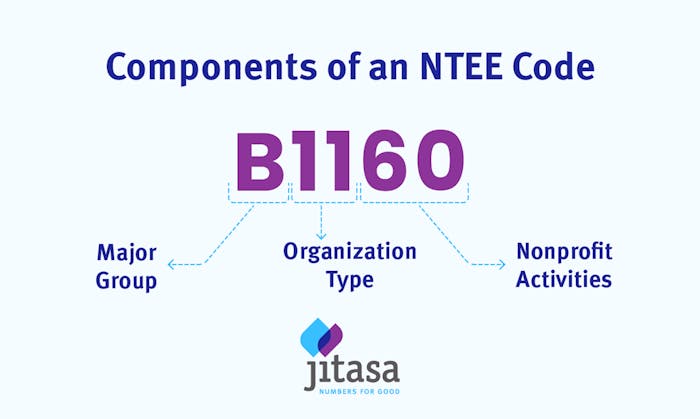
- B: This first letter lets us know that the organization’s primary role is in the field of education.
- 11: This second part of the code means that the organization’s function is monetary support of a single entity.
- 60: This last number refers to the specific activity area of the organization—in this case, adult education.
Nonprofit professionals should have a firm understanding of NTEE codes, as they influence everything from funding opportunities to partnership possibilities.
How do I find my nonprofit’s current NTEE code?
When you register a new nonprofit, the IRS will assign it a code based on the description of its activities on its Form 1023. To find your nonprofit’s current NTEE code, follow these steps:
- Ensure you have a program for viewing CSV files.
- Navigate to the IRS’s website and the IRS 990 Business Master File.
- Select the state or region where your nonprofit files its taxes to download the CSV file.
- Search for your nonprofit in the file.
As of November 15, 2025, the IRS has 1,923,040 NTEE codes on file. When looking up your nonprofit, we recommend using search functions so you can find the information you need quickly.
How can I change my nonprofit’s NTEE code?
In some cases, particularly for nonprofits with complex or wide-spanning missions, the NTEE code the IRS assigns to your nonprofit may not be completely accurate. If this applies to your nonprofit, you can request a change to your NTEE code by following these steps:
- Write a request that includes your nonprofit organization’s name, EIN, current NTEE code, new proposed NTEE code, and an explanation of why the change is necessary.
- Include any relevant documents, such as an updated mission statement or description of programmatic activities.
- Mail or fax your request to the IRS Correspondence Unit. Their mailing address is:
Internal Revenue Service
Attn: Correspondence Unit
P.O. Box 2508, Room 6403
Cincinnati, Ohio 45201
Additionally, referencing your code change request on your Form 990 is optional, but it can help attract the IRS’s attention to your request if you haven’t received a response.
Why Accurate NTEE Code Classification Matters
An NTEE code informs regulatory bodies about your nonprofit’s purpose and activities, facilitating appropriate oversight and compliance. Think of it as a regulatory passport, ensuring safe passage through the complex terrain of legal requirements and tax obligations. Accurate classification leads to streamlined reporting, enhancing transparency and trustworthiness in the eyes of authorities and the public.
One of the most tangible benefits of accurate NTEE classification is its influence on funding opportunities. Grantmakers, financial supporters, and government agencies often allocate resources based on specific categories and missions that align with their own objectives.
For example, consider a for-profit company building out a corporate philanthropy program. If one of that company’s core values is continued education, they might quickly scan a list of NTEE codes and look for nonprofits with the first initial “B” to include in their philanthropy program.
If your nonprofit is accurately classified under the right NTEE code, these entities are more likely to identify and support it, unlocking potential major streams of funding.
Tax exemptions, a critical aspect of nonprofit financial health, are also contingent upon your organization's alignment with certain mission-based criteria. Classifying the right NTEE code on your organization’s Form 1023 ensures it’ll be recognized for its tax-exempt status under the correct parameters.
How to Determine Your Nonprofit’s NTEE Code
Navigating the labyrinth of NTEE codes may seem daunting at first glance. However, with a clear roadmap and the right tools, pinpointing the appropriate NTEE code for your nonprofit can drive better financial results across the board. Follow these steps to get started:
- Understand your mission and activities: Begin with a deep dive into your nonprofit's mission statement, goals, and primary activities. Knowing your organization’s core purpose and function is crucial before you even glance at the NTEE classification system.
- Review the NTEE code list: Familiarize yourself with the NTEE classification system as described above. This hierarchical structure can also be found on the IRS website or other nonprofit resource platforms.
- Match your activities to broad categories: Start by identifying which of the major NTEE categories best aligns with your overarching mission. Are you primarily focused on education, health, arts, or another field? Select the category that most closely reflects your nonprofit's primary focus.
- Refine your classification: Once you've identified a broad category, drill down into the subcategories. Compare your specific activities, services, and programs against detailed descriptions of the subcategories to find the best match.
- Consult with stakeholders: Engage your board, staff, and possibly an external financial advisor to review and discuss the most fitting NTEE code. A collaborative approach ensures a comprehensive perspective that takes into account all facets of your organization’s operations.
- Validate your choice: Cross-reference your selected NTEE code with similar organizations and case studies. This validation step can confirm whether your choice aligns with standard practices within your sector.
By following these steps and using available resources, your nonprofit can navigate the complexities of NTEE codes with confidence. To start creating your code, explore the major groups below.
Each major group has several category-specific activity options to choose from, which will define the rest of its code. The National Center for Charitable Statistics provides a complete list of all unique code combinations for each group.
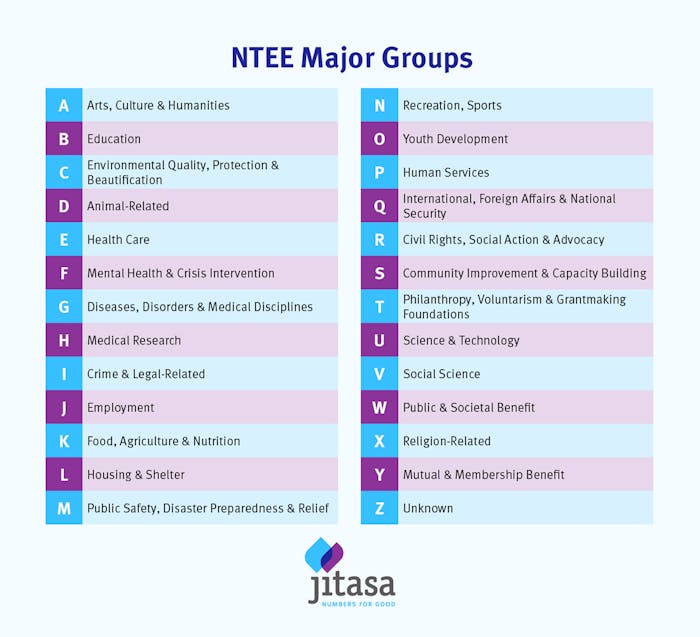
For example, let’s say your nonprofit is a social sciences research organization that primarily conducts advocacy work related to urban development. In this case, your code would be V (social science) 01 (alliance and advocacy organizations) 34 (urban studies). This number is technically two NTEE codes, V01 and V34, combined to make one code. A complete code offers a full picture of your nonprofit, but each individual code is acceptable.
NTEE Codes & Nonprofit Financial Management
Nonprofit financial management requires organizations to consider many components, including their overall mission, fundraising strategies, accounting procedures, and other operations. Among these components, an NTEE code might not stand out at first glance. However, it significantly impacts financial reporting, transparency, and strategic planning.
Accurate NTEE classification ensures that financial statements, tax filings, and donor reports align with the specific standards and regulations applicable to your sector. This alignment promotes transparency, which helps build trust with supporters, regulators, and the public.
Strategic Planning: NTEE Codes’ Influence on Financial Strategies and Funding Opportunities
Beyond compliance, the correct NTEE code opens the door to tailored financial strategies and funding opportunities. Different sectors attract different types of funding— for example, grants available to educational nonprofits may not be accessible to those in the health sector. By aligning your organization's classification with its primary mission, you ensure a better fit with potential funders' interests, leading to more successful funding applications and partnerships.
Moreover, your NTEE classification can influence budgeting and financial planning. Understanding the typical expenses, revenue streams, and financial challenges of nonprofits within your category can provide valuable benchmarks and insights. For example, nonprofits within the field of higher education may receive the majority of their revenue through tuition payments, while churches often rely more heavily on congregational tithing.
This knowledge enables more informed decision-making, from budget allocations to strategic investments, ensuring your organization’s resources go toward the most impactful activities.
Fostering Trust: How NTEE Codes Aid in Compliance for Financial Advantage
Adhering to compliance best practices can provide a financial advantage to your nonprofit. Plus, it shows supporters that your organization is trustworthy and will use their contributions to create the greatest impact for your mission. Here are some steps you can follow to ensure compliance regarding NTEE codes:
- Regularly review and update your code: As your organization evolves, so should your NTEE classification. Regularly review your code to ensure it reflects your current operations and mission, and apply for new ones as is necessary to reduce the risk of missed opportunities or regulatory missteps.
- Educate your team: Ensure your financial team understands the significance of your NTEE code and how it relates to your financial practices and reporting requirements. This shared understanding reinforces the importance of accuracy in all financial matters.
- Integrate into financial processes: Embed your NTEE code into your financial processes and systems, from accounting software to internal reporting templates. This integration ensures that all financial activities are aligned with your classified mission.
- Leverage for funding and partnerships: Use your NTEE classification proactively in grant applications, fundraising campaigns, and partnership pitches. Highlighting your alignment with specific sectors can strengthen your case for support and open new avenues for resources.
The best way to ensure compliance in all of your organization’s financial management activities, including NTEE classification, is to work with experienced nonprofit accountants like our team at Jitasa. We’ll not only help your organization determine the right NTEE code to describe its purpose but also work with you to configure your financial practices and tools, so they help you fulfill that purpose as effectively as possible.
In the grand scheme of nonprofit management, an NTEE code serves as more than just a label. It can be an integral component of your organization’s financial strategy and organizational identity. By understanding and leveraging these classifications, your nonprofit can not only meet compliance standards but also unlock new opportunities for growth.
If you’re interested in working with a nonprofit accountant to help your organization ensure transparency and accountability in its finances, contact our team at Jitasa to request a quote! In the meantime, here are some additional resources you can explore for more guidance:
- 12+ Top Nonprofit Accounting Firms & How to Choose One. Explore our top picks for outsourced nonprofit accountants who can help your organization determine and apply its NTEE code.
- Nonprofit Bookkeeper vs. Accountant: What’s the Difference? Once your nonprofit has its NTEE code set, you can start applying for new funding. Ensure your nonprofit has a bookkeeper and accountant who can help.
- What is a Fractional CFO for Nonprofits? The Ultimate Guide. Your CFO can help your nonprofit determine what its NTEE code should be. Discover how a fractional CFO can provide the support your nonprofit needs.
Work with Jitasa to get the financial insight you need to seek new funding opportunities.
Request a Quote