

Key Tax Considerations for Your Nonprofit's Next Event
Tuesday, April 14, 2026 by Guest Post - Bonterra Team
Events are essential for stewarding donors and generating revenue, but managing them can be complicated and costly. To stay on track, you'll need to create a detailed event budget to account for the direct financial investment of reserving the venue, catering, advertising, and your team's time.
In addition to the costs of planning and running the event, event revenue also has specific tax considerations that nonprofits must be aware of.
To ensure your organization hosts a financially responsible and compliant event, we'll go over the key tax considerations to keep on your radar. While it's recommended that you consult a legal or financial professional to navigate any tax implications associated with your event, this guide is a great starting point.
Basics of Special Events
The IRS terms fundraising events as 'special events.' A few examples under this umbrella, according to the IRS, are: "dinners/dances, door-to-door sales of merchandise, concerts, carnivals, sports events, and auctions." Essentially, special events are considered fundraisers that do not substantially further the organization's exempt purpose other than by raising funds.
The total earnings from a special event, or gross income, must be reported annually on the IRS Form 990, which is how the IRS gathers data about tax-exempt organizations. Line 8a of Form 990 explains that fundraising events exclude:
- Sales or gifts of goods or services of only nominal value
- Raffles or lotteries in which prizes have only nominal value
- Solicitation campaigns that generate only contributions
Keep in mind that events unrelated to your exempt purpose can, in certain circumstances, be considered taxable unrelated business income (UBI), which we'll cover in a later section. However, your event may be exempt from UBI as long as it is hosted irregularly (e.g., once a year rather than every month), run by volunteers, and not held for profit.
Form 990 Special Event Considerations
If your nonprofit receives income from fundraising events during a given fiscal year, you'll need to report it using Form 990, along with the other revenue your nonprofit receives from individual giving, grant funding, etc.
Your nonprofit will be required to submit the following details about your fundraising events:
- Name of the event
- Total revenue generated
- Total fair market value (FMV) of noncash contributions
If your nonprofit reports gross event revenue totaling more than $15,000, you will also be required to fill out Form 990 Schedule G, Part II. This schedule is used to report on professional fundraising services and special events, like galas or auctions, in greater detail. For example, you'll need to record costs incurred with your fundraising events, such as:
- Cash and noncash prizes
- Food and beverages
- Entertainment
- Rent/facility costs
- Other direct expenses
The IRS also requires your nonprofit to inform donors of tax deductibility for event tickets or purchases of $75 or more. Disclosing that you have complied with this rule is one of the questions on Form 990 and is essential to avoid unnecessary legal or financial penalties.
Because there might be several months between your nonprofit's event and when your organization prepares and files your annual Form 990, make sure you don't accidentally leave a fundraising event off your reporting. As part of your post-event tasks, document all of the necessary tax information you'll need for the Form 990 within your nonprofit CRM.
Sales Tax Considerations
Depending on your location, your nonprofit may also be subject to collecting state and local sales taxes. Sales tax can be pretty straightforward if your nonprofit has regular revenue-generating activities through the sale of goods, like retail operations.
When it comes to event-generated revenue, tickets to an event could potentially be sales-tax eligible. If your nonprofit sells food or drinks, or that's included in the ticket price, this could also be sales-tax eligible, depending on your state's tax code. Keep in mind that the sales tax in the event venue's location will likely determine the tax percentage. For instance, if your nonprofit is located in the city of Atlanta but the event venue is in a different county, sales related to the event must comply with that county's tax rate.
Consult with a nonprofit financial professional to ensure you're remaining compliant with sales taxes in your region on the different income sources from your event. Then, apply that to ticket prices and other sales related to your event in your fundraising software to ensure you collect the right amounts.
Corporate Sponsorship and UBI Considerations
Corporate sponsorships can help your nonprofit in a variety of ways, from covering event costs to securing in-kind contributions like auction items. However, corporate sponsorships can fall under unrelated business income (UBI) in certain circumstances, meaning that this income could be taxable.
Advertising
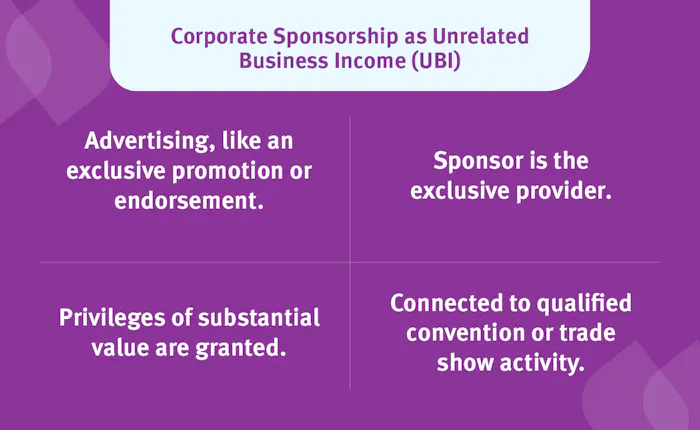
A corporate sponsorship may be considered UBI if it crosses over into advertising. IRC Section 513(i) explains that a corporate sponsorship may be considered advertising if your nonprofit explicitly promotes the products or services of a person or company, including using "messages containing qualitative or comparative language, price information, or other indications of savings or value, an endorsement, or an inducement to purchase, sell, or use such products or services."
For instance, let's say your nonprofit is hosting an online fundraiser, and you partner with a company to match gifts during your campaign. Here are two examples of a social media post your nonprofit might share to acknowledge the business's support and show appreciation:
- "Huge thank you to [Company Name] for matching gifts during this campaign!"
- "Thank you to [Company Name]! They are the leading provider in selling quality products, so purchase something from them today!"
Option 1 is not an advertisement, so your nonprofit would not be taxed. On the other hand, the second option would make you tax-liable, because it is an endorsement.
Sponsor Privileges
Corporate sponsorships can also fall under UBI if any of the following situations apply:
- The sponsor is deemed to be the exclusive provider
- Your nonprofit provides privileges like facilities or services to the sponsor that are considered to be of substantial value
- The sponsorship payment is connected to a qualified convention or trade show activity
Before you reach out to potential corporate sponsors for your event, determine the nature of sponsor benefits (like advertising and privileges), taking tax liability into account, and make that clear in your sponsorship letter.
Games of Chance
Corporate sponsorships aren't the only source of revenue that could fall under UBI. Another common funding source of revenue that may be considered taxable is gaming. If you're planning to host an event that involves raffles, bingo, lotteries, or other games of chance, you'll want to reference both IRS provisions and state and local law to ensure you're legally compliant.
If your nonprofit earns $1,000 or more in UBI, you will be required to fill out IRS Form 990-T. This form is due at the same time as Form 990. For more information on unrelated business income, reference IRS Publication 598: Tax on Unrelated Business Income for Exempt Organizations.
When planning your next event, take into account these key tax considerations to ensure compliance and save your nonprofit from spending any extra unnecessary funds. You can always work with a top accounting firm that specializes in nonprofit financial management to simplify filing your taxes.

Jitasa’s bookkeeping and accounting services are affordable and cater to every nonprofit.
Learn More